
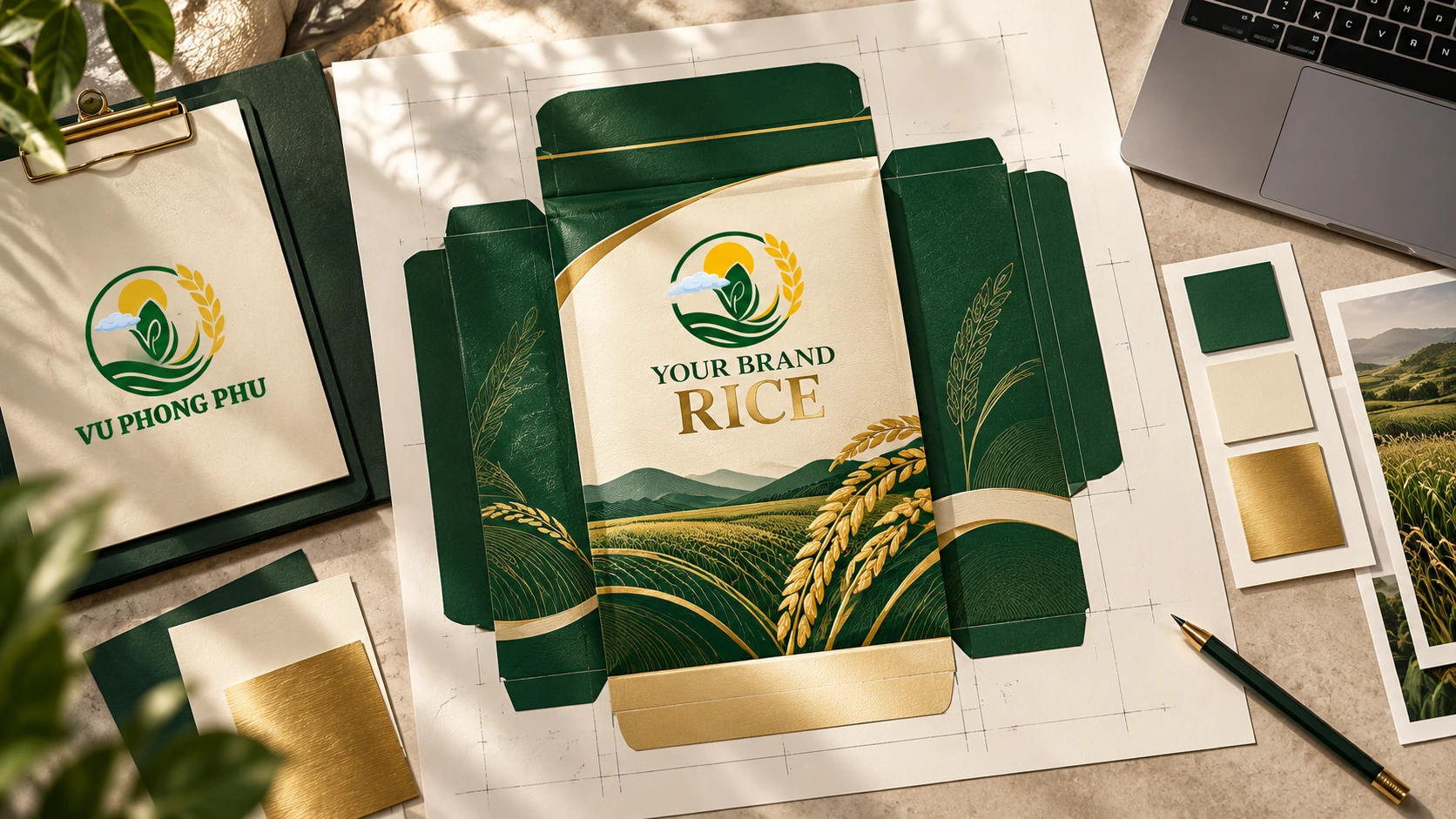
The most expensive artwork mistake may be a small one: the wrong net weight, an obsolete address, a barcode assigned to another product, or a certification mark used outside its permitted scope. Once bags are printed, correcting the screen file does not correct the physical stock.
A rice packaging artwork checklist should connect three approvals: what the product is, what the destination allows the label to say, and what the printer can reproduce. Treat those as distinct reviews, with a named owner for each.
Confirm the brand and the product before editing the design
Record the brand owner and authorization to use its trademarks, logos and supplied images. Confirm who may approve artwork on behalf of that owner. A designer’s email accepting the appearance is not necessarily authorization to manufacture branded packaging.
Match the product name to the approved rice specification. Check variety, milling description and any blend declaration against the actual goods. Do not carry the name of one rice variety into a new SKU simply because the previous bag provides a convenient template. Link each file to a product code and pack weight.
If the product decision is still open, return to the private label launch roadmap. Printing should follow product approval, rather than forcing a product choice because packaging has already been purchased.
Give destination review its own approval line
The buyer should identify the relevant market requirements and the person checking them. Review the language, product description, weight statement, business details, origin declaration, dates, storage information and any nutrition or ingredient information that applies to that product and destination.
This is a review list, not a universal statement that every field is mandatory in every market. The Codex standards index includes the General Standard for the Labelling of Prepackaged Foods, CXS 1-1985. It is a useful international reference; the destination’s applicable rules still need separate confirmation.
Check translations with someone competent in the market language. Compare each translated claim with the approved original; fluent wording can still change the meaning. Make sure the importer’s or distributor’s details are current and reflect the role required for that market.

Separate supported facts from attractive claims
List every claim on the front and back of the bag, including small icons. For each, identify the evidence, the product or facility it concerns, the period for which it remains valid and any permission needed to display it. Avoid unsupported organic, medical, sustainability or certification statements.
For a Halal mark, verify the issuer, covered product and authorized use instead of assuming the company’s certificate applies to all rice. The quality page provides the company’s available certificate information. The Halal scope guide explains what to match before treating a certificate as product evidence.
Review the file as a physical printed bag
| Check | Question for approval |
|---|---|
| Dieline and dimensions | Is this the printer’s current template for this bag? |
| Trim, bleed and safe areas | Can essential text avoid cuts, seals, folds and seams? |
| Fonts and images | Are assets usable at the intended print size and files supplied as required? |
| Colour reference | What proof or physical sample defines the accepted colour? |
| Barcode | Does it identify the correct SKU, and has scan performance been checked? |
| Variable data | Where will lot and date information be applied and verified? |
| Orientation | Are front, back and side panels correct when the bag is filled? |
Confirm the technical requirements with the actual printer. There is no single image-resolution or colour-file rule that suits every process. A raster image that looks sharp on a laptop may not remain sharp on a large bag, while a logo supplied as vector artwork may behave differently. Ask for a proof that reflects the intended output.
Inspect a filled sample where appropriate. A bag can look balanced when flat but hide text in a fold or distort the brand when filled. Include practical checks for readable date coding, seam placement and handling. Record any difference between the design proof and the physical sample.
Control versions so the right file reaches production
Use one final file identifier containing the product code, pack size and version. Keep obsolete files away from the production handover. Changes should be described explicitly, even if the new artwork looks nearly identical to the previous version.
A useful sign-off record includes the artwork identifier; product and packaging specification references; destination review owner; brand approval; printer proof approval; approval date; and unresolved conditions. Store the approved file with that record. Avoid approval messages such as “looks good” that do not identify what was reviewed.
Before a repeat order, confirm whether the addresses, barcode, certification permission and declarations remain current. If a change affects existing bag stock, agree how to handle that stock before authorizing a new version. See the MOQ guide for why printing quantity and filling quantity may need separate decisions.
Have an artwork draft ready? Review our OEM workflow and bring the file, destination requirements and selected rice specification to a project discussion. That gives the brand owner, manufacturer and printer a clear basis for the next approval.