
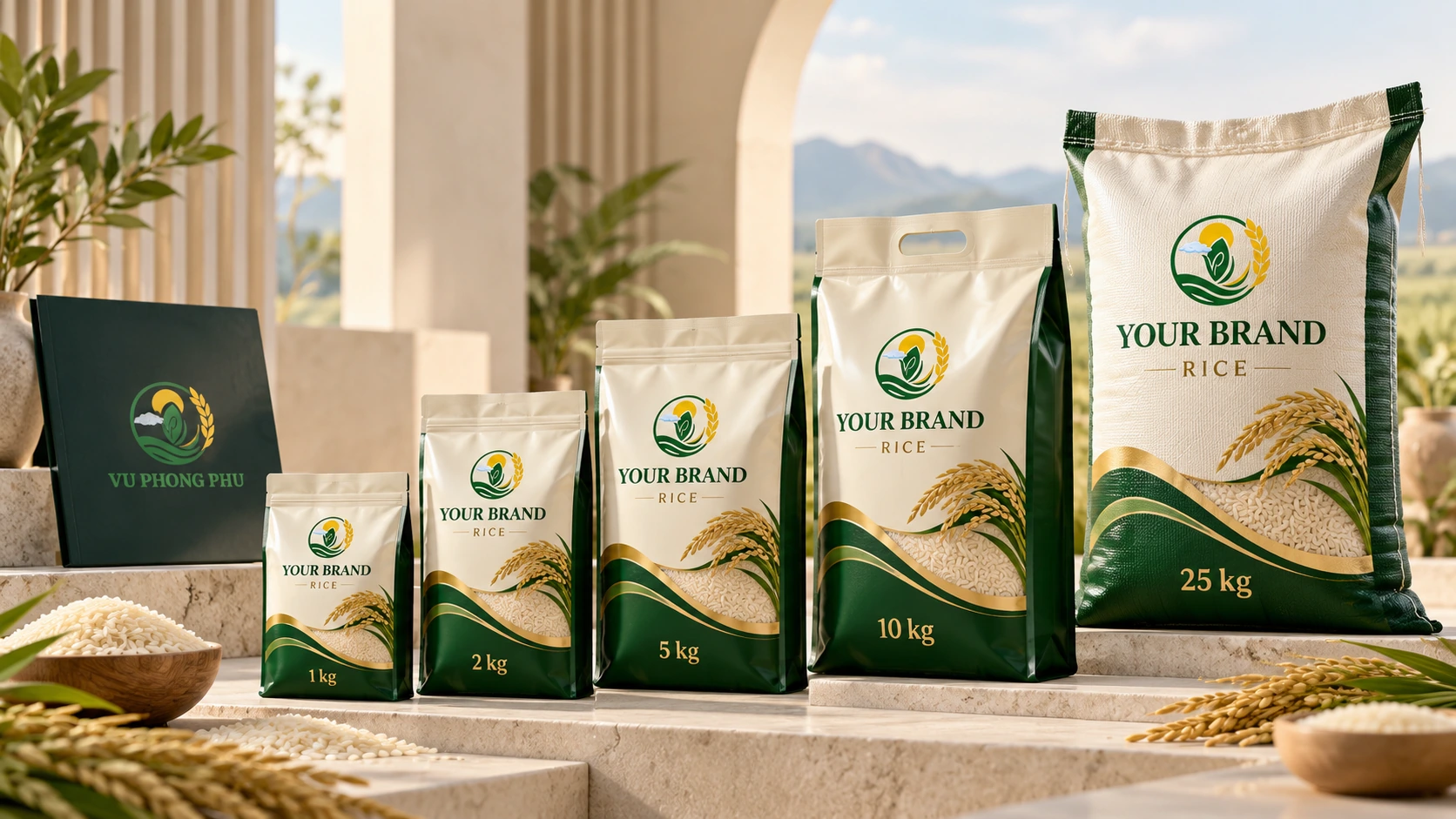
Rice packaging sizes for retail and wholesale affect more than the price printed on a shelf ticket. Pack weight changes how a customer carries rice, how long a household uses an opened bag and how a kitchen handles daily replenishment. For an OEM launch, the best starting assortment is a small set of sizes with clear jobs. Listing every size from 1 kg to 50 kg can add operational complexity without proving demand.
Give each proposed size a customer job
A smaller retail pack may help a shopper try an unfamiliar variety or fit a limited storage space. A larger household pack may suit repeat purchase, provided the handling and after-opening routine work for that household. These are hypotheses to test, not claims that every country prefers the same weight. Ask the retailer about shelf dimensions, shopper feedback and its existing category structure before selecting sizes for a new brand.
Foodservice has a different decision. A kitchen needs an appropriate quantity for its consumption, storage area and staff workflow. A large bag is not automatically the most efficient choice if it is awkward to lift, difficult to identify after opening or too slow to use. Compare the rice portfolio alongside the pack routine: the grain must suit the menu, while the weight must suit the people and facility handling it.
Build a simple size-and-channel matrix
Treat 1 kg and 2 kg as possible trial or smaller-household candidates; treat 5 kg and 10 kg as possible repeat-purchase candidates; evaluate 25 kg and 50 kg against specific wholesale and kitchen handling arrangements. This is an illustrative planning framework, not a market-share claim or confirmation of available production formats. Ask the supplier which combinations of variety, structure and weight can actually be assessed for your project.
For each proposed size record the intended shopper or operator, storage location, expected replenishment pattern, display arrangement and handling concerns. If two sizes serve exactly the same job, explain why both are needed. A premium supermarket launch might begin with a trial size and a household size, while its hospitality channel uses a separate bulk format. Do not assume the same printed pack can satisfy both routes without changes to information or presentation.

Compare total execution cost, not only bag cost
Calculate costs on consistent terms: product quantity, packaging, secondary packing where used, printing setup, packing operations and distribution assumptions. A smaller bag can create more individual units per tonne, but this does not establish a fixed cost advantage or disadvantage without quotations. Ask for the pack count and gross configuration used in each estimate. Avoid comparing a retail-ready carton proposal with a loose-bag quote as if they were equivalent offers.
More sizes also create more artwork versions, inventory lines and replenishment decisions. GS1 describes the role of product identification in its GTIN guidance. Ask the brand owner and retailer to determine the correct identifiers for the assortment and packaging levels. A barcode that scans is not enough if the retailer's master data describes a different weight, name or ordering unit. Include those records in the launch review.
Pilot the handling and replenishment assumptions
Use filled mock-ups or production-representative samples to test shelf fit, carrying, opening and pouring. Ask store staff how they will replenish the display and kitchen staff how they will store an opened pack. Record problems such as an unstable upright bag, a bulky carton or unclear lot information. Keep material performance questions in the separate packaging materials review, so a preferred weight does not prematurely lock the wrong construction.
In a hypothetical pilot, a retailer can compare a small trial pack with a larger household pack while keeping the same rice and core brand promise. Review actual reorder patterns and staff feedback before expanding the range. The pilot should have an observation period and a decision owner, but it should not invent predicted sales or promise a guaranteed sell-through. If results are weak, change one major variable at a time to understand what caused the response.
Send a brief that supports a useful quotation
State the rice, destination, channel, candidate weights, initial volume assumptions and expected repeat-order pattern. Include shelf or kitchen constraints and ask which formats need further validation. Through the private label discussion, agree the final weight, construction, unit count and approved artwork for each SKU. A disciplined size plan gives each pack a reason to exist and makes future expansion easier to manage.
- Customer job for each size
- Confirmed shelf fit
- Ordering-unit data
- Handling feedback
- Pilot review decision